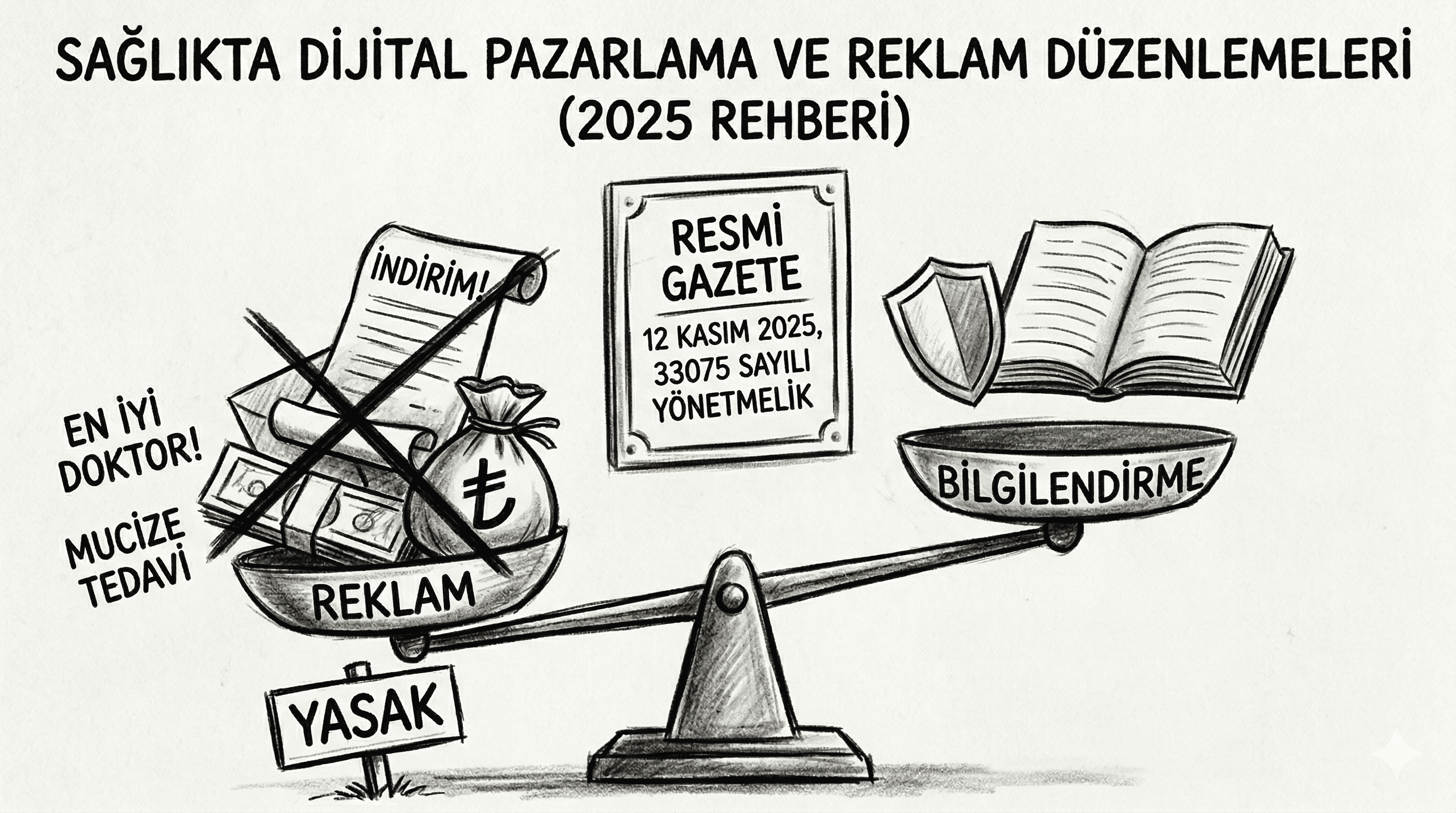
Healthcare has become one of the most heavily regulated verticals in digital marketing worldwide. In Türkiye, this landscape was radically reshaped by the “Regulation on Promotional and Informative Activities in Health Services” published in the Official Gazette No. 33075 on 12 November 2025. The once‑blurry line between “advertising” and “information” has effectively turned into a thick legal wall guarded by heavy sanctions.
This article brings together the 2025/2026 health promotion rules, the Ministry of Trade’s advertising regulations and the health policies of platforms such as Google and Meta, to serve as a practical compliance and strategy guide for digital marketers and healthcare managers.

1. Foundation of the New Era: 12 November 2025 Health Promotion Regulation
1.1. Advertising vs. Information: Legal Framework
The Regulation on Promotional and Informative Activities in Health Services dated 12 November 2025 is the primary legal source that defines which digital communications in healthcare are legitimate and which are prohibited. Its purpose is to set out the basic principles and criteria for promotional and informative activities in health services, to regulate the supervision of these activities and to define applicable sanctions.
The Regulation applies to:
Health professionals (physicians, dentists, pharmacists, nurses, etc.),
Private healthcare institutions (hospitals, medical centers, polyclinics, outpatient clinics),
International health tourism intermediary institutions,
and covers all of their promotional and informative activities.
It strictly prohibits any activity that qualifies as “advertising” – that is, any communication intended to generate or increase demand or to persuade people with commercial motives – both in explicit and “covert” forms, and only allows a narrow space for informative activities that enlighten, protect and improve public health.
The Turkish Medical Association has long underlined in its deontological opinions that advertising is absolutely forbidden for physicians and healthcare institutions, while limited “promotion” may be acceptable within strict boundaries, especially pointing to grey areas where online and social media content easily slides from information into advertising.
1.2. Core Prohibition: Explicit and Covert Advertising
One of the key provisions of the Regulation is the prohibition of explicit or covert advertising in the provision of health services. This ban applies to:
Personal accounts of physicians,
Corporate accounts of clinics/hospitals,
Health tourism intermediaries,
making it unlawful for them to place digital ads, while allowing only strictly compliant informative communication.
Commercially incentivising wording (discount, campaign, promotion, package price, “best”, “most successful”, “only”, “guaranteed solution”, “miracle treatment”, etc.) is considered a direct violation for audiences located in Türkiye. Similarly, package pricing and explicit fee disclosures (e.g. “implant + bleaching package price”) are prohibited in communications targeting domestic audiences.
2. What Is Banned and What Is Allowed? Semantic and Strategic Boundaries
2.1. Copy, Pricing, Social Proof and Visual Use
The health promotion Regulation and the Regulation on Commercial Advertising and Unfair Commercial Practices of the Ministry of Trade draw a very clear line in digital messaging.
Prohibited (for domestic audiences):
Demand‑creating, persuasive copy with superiority claims (e.g. “the best surgeon in Türkiye”, “guaranteed solution”)
Discounts, campaigns, promotions, lotteries, gift vouchers
Package deals, explicit price points and “cheap”, “most affordable” type price‑driven wording
Systematic use of patient thanks and reviews as visible “social proof” to attract patients
Comparative statements against competitors that create unfair competition
Claims about non‑evidence‑based methods presented as treatment
Allowed (within the informative framework):
Address, contact details, official working hours
List of specialties and service units
Officially registered academic titles, publications, congress participation and professional memberships
Scientific content that protects, improves and prevents ill‑health
Informative explanations on processes and risks that do not imply pricing
In addition, the Ministry of Trade’s advertising rules prohibit any commercial advertising that misleads or exploits consumers’ lack of experience or knowledge, endangers public health or constitutes unfair commercial practice, with the Advertising Board overseeing compliance and imposing sanctions.
2.2. Before‑and‑After Images and Consent
Before‑and‑after images were almost entirely banned under the 2023 wording, but the 2025 Regulation opens a very narrow and heavily regulated space for them, which still remains one of the riskiest areas.
Key conditions include:
Obtaining written explicit consent from the patient (Visual Content Recording and Processing Consent Form – Annex‑1).
Shooting images under identical technical conditions, without filters or manipulation.
Displaying both the date of the procedure and the date of imaging on the visual.
Including a clear disclaimer that outcomes vary from person to person.
Not publishing intra‑operative, bloody or intimate images that jeopardise perceptions of sterility or privacy.
Providing financial benefits to patients in return for the use of their images (payments, discounts, gifts, etc.) is also prohibited and considered unethical.
2.3. Comments, Likes and Engagement Restrictions
Another aspect that directly affects social media algorithms is the obligation to disable interactions such as comments, likes and shares on posts that include patient images or experiences.
Comments and thank‑you messages must not be used as visible “social proof” or covert advertising.
As a result, organic reach is significantly limited on platforms like Meta, which rely on engagement signals for distribution, pushing healthcare brands towards high‑information, save‑worthy and re‑watchable content instead of engagement‑driven visuals.
3. Domestic vs. International: Legal Loopholes in the Advertising Ban
3.1. Domestic Rule of Thumb: No Ads, Only Information
For users residing in Türkiye, the rule of thumb is:
Explicit or covert advertising is prohibited.
No demand‑creating or commercially incentivising digital ad campaigns (Google Ads, Meta Ads, etc.) can be lawfully run.
Organic informative content via websites, blogs and social media posts is allowed as long as it complies with the Regulation.
Additionally, the Ministry of Trade’s Regulation on Commercial Advertising and Unfair Commercial Practices imposes heavy sanctions on misleading, incomplete or unfair advertising across all sectors, including healthcare.
3.2. International Targeting: A Narrow Window for Health Tourism
The major and strategically critical exception – the real “legal loophole” – lies in International Health Tourism.
The Regulation allows healthcare institutions and intermediaries with a valid health tourism authorisation from the Ministry of Health to:
Promote in languages other than Turkish (English, Arabic, Russian, German, etc.),
Run separate websites and social media accounts dedicated to foreign audiences,
Use discount, campaign, package price and promotion messages,
Share foreign patient testimonials and experiences with explicit consent,
subject to strict conditions.
The critical caveat: users located within Türkiye’s borders (citizens or foreigners) must not be exposed to these international ads. This requires:
Excluding Türkiye in location settings on Google Ads, Meta Ads, TikTok Ads, etc.,
Implementing robust IP‑based geo‑blocking at the website level,
Avoiding overly broad target settings like “Worldwide” unless carefully segmented.
All international creative must also include the official national health brand “HealthTürkiye” logo, and domains, brand names and social handles must exactly match the legal name registered with the Ministry of Health, closing the door to generic, unofficial lead‑generation domains.
3.3. Opening Period and New Technology Exception
The Regulation does not entirely close the door on paid visibility for domestic audiences; it offers two narrow exceptions:
A one‑month opening period following the start of operations, during which a healthcare facility may run limited sponsored content solely to announce its existence,
Informative sponsored content to announce new medical technologies or techniques approved by the Ministry.
Even in these cases, using price, discount, campaign or superiority claims is prohibited; the content must remain within the informative scope.
4. Global Platform Policies: Algorithmic Barriers on Top of Local Law
Beyond Türkiye’s legal framework, global platforms such as Google and Meta impose their own health‑related ad policies, adding another enforcement layer for digital marketers.
4.1. Google Ads: YMYL, Health Certifications and Suspensions
Google classifies health as a “Your Money or Your Life (YMYL)” category, meaning content and ads are subject to extraordinary scrutiny because they directly affect people’s lives.
Policies are extremely restrictive for prescription drugs, medical devices and speculative or experimental treatments.
Landing pages are scanned not only for visible copy but also for source code, alt‑texts and outbound links.
“Circumventing systems” and “speculative/experimental medical treatment” violations may trigger account suspensions.
With its late‑2025 policy update, Google introduced a 7‑day warning phase before permanent suspension in certain violations, providing a critical window for healthcare advertisers to clean up their landing pages and align with policy.
4.2. Meta (Facebook/Instagram): Health Data, Pixel and Signal Loss
Meta significantly restricted pixel‑based tracking and conversions for health‑related websites due to the sensitivity of health data.
Events such as “appointment booked” or “form submitted” from health domains are treated as sharing sensitive health information with the platform and are therefore limited.
Targeting based on sensitive health interests or conditions is being phased out.
Retargeting and lookalike audiences are largely ineffective for healthcare verticals.
Healthcare brands are thus pushed away from bottom‑funnel conversion optimisation towards top‑funnel metrics (impressions, video views, profile visits), and must rely on server‑side Conversions API solutions with anonymised data to measure performance.
5. Organic Strategies and SEO: Growth in a No‑Ads World
5.1. Content Marketing: From Advertising Funnel to Information Funnel
Legal and platform restrictions make classic performance marketing (CTA, FOMO, discounts, campaigns) practically impossible in healthcare; instead, brands must pivot to content‑driven models.
Focus on long‑tail, informational keywords that mirror user intent (e.g. “post‑operative recovery after microdiscectomy for lumbar disc herniation”).
Provide clear, medically accurate explanations of disease courses, risks and recovery processes via blog posts and videos.
Build E‑E‑A‑T (Experience, Expertise, Authoritativeness, Trustworthiness) by highlighting the physician’s credentials and scientific footprint.
Avoiding “best, cheapest, price” type terms and instead investing in educational, trust‑based content satisfies both Google’s YMYL/E‑E‑A‑T requirements and local health promotion rules.
5.2. Technical SEO, UX and Local Presence
On the technical side:
Mobile‑friendly, fast‑loading pages with HTTPS and data‑protection‑compliant forms,
Proper heading hierarchy (H1, H2, H3) and fully defined alt‑texts for images,
A logical site architecture that guides users from information pages to physician profiles and then to contact pages
are essential for both user experience and Google rankings.
At the local level, a complete Google Business Profile with accurate address, working hours, specialties and exterior photos offers a fully compliant, high‑ROI visibility channel for clinics.
6. Sanctions: The Cost of Digital Missteps
Non‑compliant digital content can lead not just to warnings but to hard revenue cuts and career‑threatening sanctions.
For physicians:
Administrative fines under Law No. 1219 and disciplinary proceedings by professional chambers,
Temporary bans from practice in serious cases.
For private healthcare institutions:
Initial warnings for the first two violations,
Temporary suspension of the relevant department’s activities upon repeated violations,
Revocation of operating permits in severe cases.
For health tourism facilities and intermediaries:
For unauthorised persons/entities (non‑physicians):
Immediate suspension of activities by the Governor’s Office and criminal complaints to the Public Prosecutor,
Access blocking and content removal via the Information and Communication Technologies Authority (BTK).
The Advertising Board of the Ministry of Trade also orders the suspension of misleading health and tourism advertising and imposes substantial administrative fines.
7. Strategic Takeaway: The Era of Medical Digital Communication
With the 2025 health promotion Regulation, the Ministry of Trade’s advertising rules and global platform policies all in force, healthcare digital marketing is shifting from classic “advertising” to a discipline centred on medical communication and compliance.
In this new era, success belongs to those who:
Operate in full compliance with law and professional ethics,
Prioritise scientific accuracy and transparency,
Build organic E‑E‑A‑T authority,
Invest in zero‑party data and robust CRM infrastructures.
In other words, information replaces “advertising”, long‑term trust replaces aggressive growth, and regulation‑compliant sustainability replaces short‑term performance metrics. In such an ecosystem, any digital marketing plan that does not start from the Regulation, the Official Gazette and official guidance documents can no longer be considered a “strategy”.
References
Republic of Türkiye. Regulation on Promotional and Informative Activities in Health Services. Official Gazette No. 33075, 12 November 2025. https://www.resmigazete.gov.tr/eskiler/2025/11/20251112-2.htm
Republic of Türkiye Ministry of Health. Regulation on Promotional and Informative Activities in Health Services (official announcements and information pages). https://www.saglik.gov.tr
Republic of Türkiye. Regulation on Promotional and Informative Activities in Health Services (full PDF text as published and circulated by official/sectoral institutions). For example: https://www.rok.org.tr/wp-content/uploads/2024/12/Saglik-Hizmetlerinde-Tanitim-ve-Bilgilendirme-Faaliyetleri-Hk.-Yonetmelik.pdf
Republic of Türkiye Ministry of Trade. Regulation on Commercial Advertising and Unfair Commercial Practices. https://www.mevzuat.gov.tr